In 2020, Crossref’s board voted to adopt the Principles of Open Scholarly Infrastructure, and we completed our first self-assessment. We published our next reviews in March 2022 and December 2024. We are happy to present our latest self-assessment showing there are improvements in a number of areas representing steady progress but there are a few areas to work on and improve.
Ed Pentz, our Executive Director, opened the 2026 Annual Meeting by introducing the theme: Good infrastructure is patient work. Crossref provides foundational infrastructure: an open, persistent scholarly record of metadata, relationships, and identifiers that thousands of tools and services build on. Maintaining that infrastructure and creating lasting value depends on sustained collective effort. True persistence requires active governance, long-term financial commitment, and organisational stewardship.
In 2022, we committed to balancing our working practices and environmental impact, and to openly reporting on those efforts. This is our third report on Crossref’s annual carbon footprint and reflects as much our emissions as it does our learning process. Travel remains the main area of our environmental impact. In 2025, our total emissions were 170 tCO2e, a 3% increase from 2024, with travel accounting for 85% of the total. A big change this year is that we have greater visibility into our AWS-related emissions. With the full transition of our metadata registry and content registration system to the cloud and significantly increased API use, we’re seeing higher carbon costs to host and run our services.
As we approach the end of 2026, research integrity remains a critical focus for the scholarly publishing ecosystem: fast technological advancements are constantly pushing the boundaries of integrity, impacting how everyone in this space interacts with the scholarly record.
A service provided by Crossref and powered by iThenticate—Similarity Check provides editors with a user-friendly tool to help detect plagiarism.
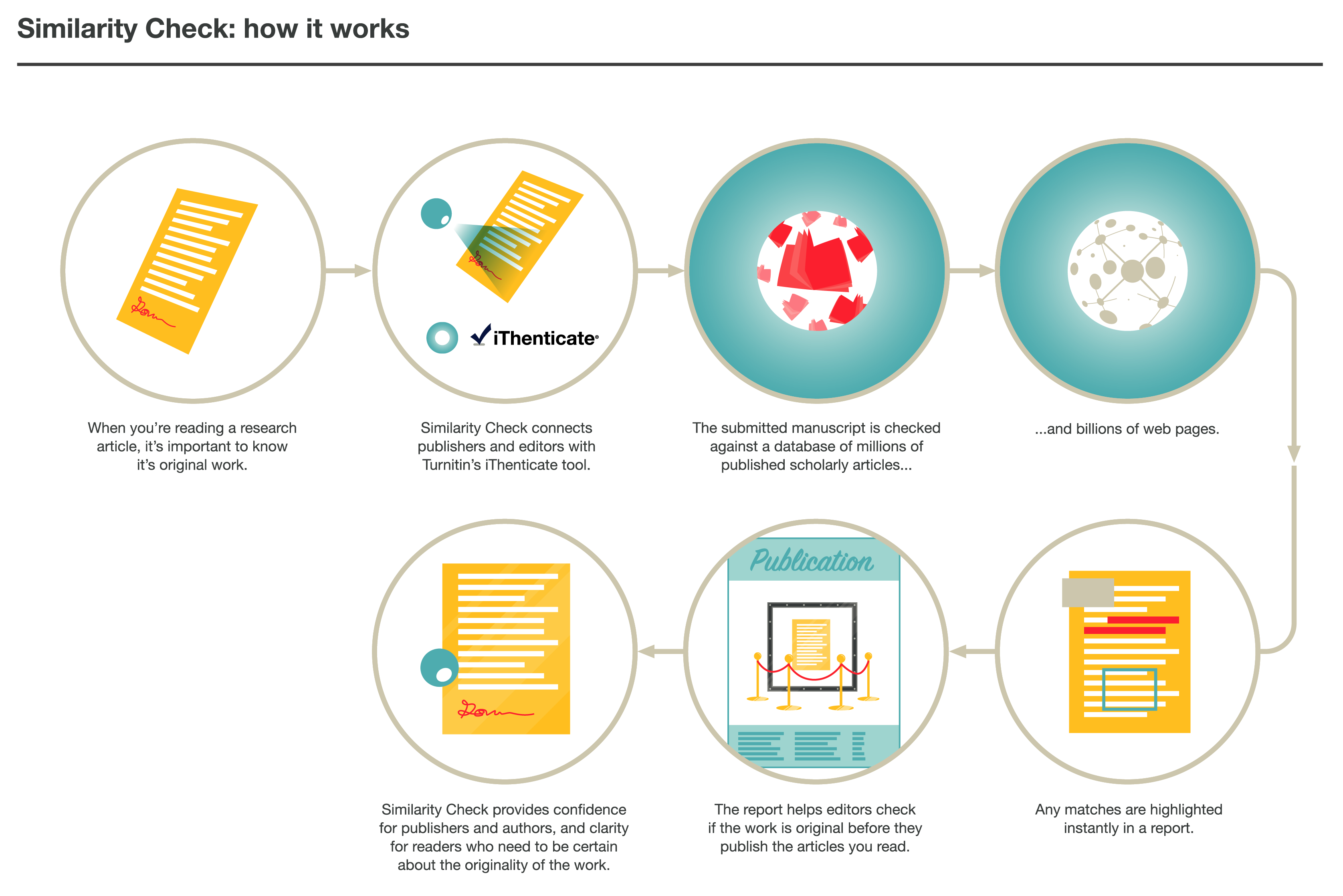
Our Similarity Check service helps Crossref members prevent scholarly and professional plagiarism by providing immediate feedback regarding a manuscript’s similarity to other published academic and general web content, through reduced-rate access to the iThenticate text comparison software from Turnitin.
Only Similarity Check members benefit from this tailored iThenticate experience that includes read-only access to the full text of articles in the Similarity Check database for comparison purposes, discounted checking fees, and unlimited user accounts per organisation.
Watch the introductory Similarity Check animation in your language:
With editors under increased pressure to assess higher volumes of manuscript submissions each year, it’s important to find a fast, cost-effective solution that can be embedded into your publishing workflows. Similarity Check allows editors to upload a paper, and instantly produces a report highlighting potential matches and indicating if and how the paper overlaps with other work. This report enables editors to assess the originality of the work before they publish it, providing confidence for publishers and authors, and evidence of trust for readers. And as the iThenticate database contains over 78 million full-text scholarly content items, editors can be confident that Similarity Check will provide a comprehensive and reliable addition to their workflow.
Making sure only original research is published provides:
peace of mind for publishers and authors that their content is identified and protected,
a way for editors to educate their authors and ensure the reputation of their publication, and
clarity for readers around who produced the work.
Benefits of Similarity Check
Similarity Check participants enjoy use of iThenticate at reduced cost because they contribute their own published content into Turnitin’s database of full-text literature. This means that as the number of participants grows, so too does the size of the database powering the service. More content in the database means greater peace of mind for editors looking to determine a manuscript’s originality.
If you participate in Similarity Check, not only do you get reduced rate access to iThenticate, but you also have the peace of mind of knowing that any similarity between your published content and manuscripts checked by other publishers will be flagged as a potential issue too.
As a Similarity Check user, you also see extra features in iThenticate, such as enhanced text-matches within the Document Viewer.
How the Similarity Check service works
To participate in Similarity Check, you need to be a member. Similarity Check subscribers allow Turnitin to index their full catalogue of current and archival published content into the iThenticate database. This means that the service is only available to members who are actively publishing DOI-assigned content and including in their metadata full-text URLs specifically for Similarity Check.
Turnitin indexes members’ content directly via its Content Intake System (CIS). Its CIS accesses our metadata daily to collect the full-text content links provided by our members within their metadata. Turnitin follows these URLs and indexes the content found at each location.
When you apply for the Similarity Check service, Turnitin will check that they can access your existing content via the full-text URLs in your Crossref metadata. Once confirmed, you’ll be provided with access to the iThenticate tool where you will be able to submit manuscripts to compare against the corpus of published academic and general web content in Turnitin’s database. You can do this in the iThenticate tool, or through your manuscript submission system using an API. iThenticate provides a Similarity Report containing a Similarity Score and a highlighted set of matches to similar text. Editors can then further review matches in order to make their own decision regarding a manuscript’s originality.
Similarity Check fees are in two parts: an annual service fee, and a per-document checking fee.
The annual service fee is 20% of your Crossref annual membership fee and is included in the renewal invoices you receive each January. When you first join Similarity Check, you’ll receive a prorated invoice for the remainder of that calendar year.
Per-document checking fees are also paid annually in January. Volume discounts apply, and your first 100 documents are free of charge.
Similarity Service status page
Check the Turnitin service status page for real-time updates on system performance and any ongoing issues that may impact your Similarity Check service.
Update 2024: We are no longer able to offer the Similarity Check service to members based in Russia. Find out more.
Page maintainer: Kathleen Luschek Last updated: 2020-April-08