Crossref members register around 37,000 records daily. All this metadata is openly shared with the global scholarly community through our free APIs. We receive over two billion calls to our API each month, signalling its use by hundreds of tools and services worldwide, supporting the discovery and assessment of scholarly metadata. As part of a new series in our blog, we will spotlight the diversity of tools and integrations that rely on Crossref metadata to serve the scholarly community. In this initial post, we chat to Luca Foppiano, the developer and maintainer of Grobid1, to learn about how Grobid uses Crossref metadata to improve the extraction and enrichment of bibliographic information from scholarly PDFs.
On behalf of the Nominating Committee, I’m pleased to share the slate of candidates for the 2026 board election. Every active member organisation is invited to submit a ballot to elect the incoming board class.
We’re providing a summary of the board’s July 2026 meeting. The July board meeting is our only in-person meeting. The board gathers for two days of strategic thinking and long-range planning, as well as conducting annual board business. This year, we focused on allocating surplus funds we have on hand to invest in a three-year project to redesign the content system. In a related discussion, we decided to lower content registration fees starting in 2027 because we’ve had a demonstrated history of generating surpluses, exceeding what we need to run Crossref. We also discussed the board structure, as part of our regular review of stakeholder governance. And we conducted annual board business, such as approving the audited financial statements and reviewed our risk register and mitigation plans.
The resolutions are available on the dedicated section of our website, which also lists the members of the Board and offers further information about our governance.
We also managed to squeeze in watching a World Cup game over dinner.
Starting today, funder names deposited in Crossref metadata without an identifier will be matched to ROR IDs, to support an open and connected Research Nexus. Funding information is an increasingly important part of the scholarly record. The improved matching strategy supports researchers, funders, institutions, and meta-researchers, who rely on that information to understand how research is supported and what outcomes that support produces.
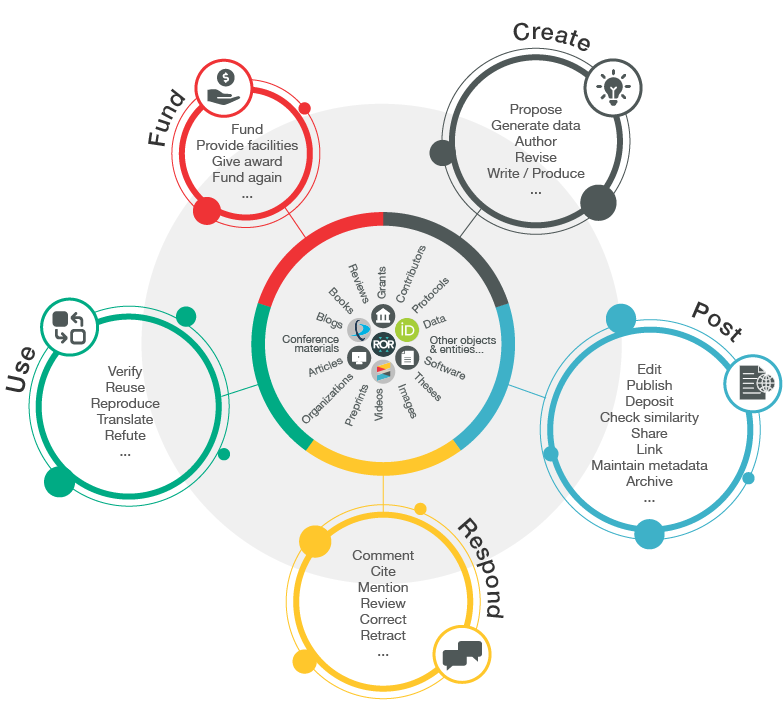
The ‘Research Nexus’ is the vision to which we aspire:
A rich and reusable open network of relationships connecting research organisations, people, things, and actions; a scholarly record that the global community can build on forever, for the benefit of society.
The Research Nexus goes beyond the basic idea of just having persistent identifiers for content. Objects and entities such as journal articles, book chapters, grants, preprints, data, software, statements, dissertations, protocols, affiliations, contributors, etc. should all be identified and that is still an important part of the picture. But what is most important is how they relate to each other and the context in which they make up the whole research ecosystem.
The foundation of the Research Nexus is metadata; the richer and more comprehensive the metadata in Crossref records, the more value there is for our members and for others, including for future generations.
Crossref Research Nexus Vision
Metadata and relationships between research objects and entities can support the whole scholarly research ecosystem in many ways, including:
Research integrity: helping to provide signals about the trustworthiness of the work including provenance information such as who funded it (when and for how much), which organisations and people contributed what, whether something was updated or corrected, and whether it was checked for originality. All of these signals can be expressed through Crossref metadata.
Reproducibility: helping others to reproduce outcomes by adding relationships between literature, data, software, protocols and methods, and more. All of these relationships can be asserted through members’ ongoing stewardship of their Crossref metadata records.
Reporting and assessment: helping organisations such as universities, funders, governments, to track and demonstrate the outcomes of investment; provide benchmarking information; show compliance with funder mandates; and decide what other research to fund. This kind of information can be included in Crossref metadata.
Discoverability: helping people and systems identify work through multiple angles. Registering content with Crossref makes it possible for work to be found and used. Thousands of systems use Crossref metadata, therefore the richer the records are, the more visibility there is likely to be of your work. Including metadata like abstracts and references are very simple ways to increase the visibility of your records.
The importance of relationships
A big part of the Research Nexus is establishing connections between and among different research objects which establishes provenance over time. Adding relationships to your metadata records can convey much richer and more nuanced connections beyond traditional references.
These relationships may consist of versions, corrections, translations, data, formats, supplements, and components. There are no extra fees for including relationships in your metadata.
What types of resources and records can be registered with Crossref?
We are working to make our input schema more flexible so that almost any type of object can be registered and distributed openly through Crossref. At the moment, members tend to register the following:
Conference proceedings: information about a single conference and records for each conference paper/proceeding.
Datasets: includes database records or collections.
Dissertations: includes single dissertations and theses, but not collections.
Grants: includes both direct funding and other types of support such as the use of equipment and facilities.
Journals and articles: at the journal title and article level, and includes supplemental materials as components.
Peer reviews: any number of reviews, reports, or comments attached to any other work that has been registered with Crossref.
Pending publications: a temporary placeholder record with minimal metadata, often used for embargoed work where a DOI needs to be shared before the full content is made available online.
Preprints and posted content: includes preprints, eprints, working papers, reports, and other types of content that has been posted but not formally published.