We’ve had a year full of growth and reached a milestone of 60+ team members; let’s take a moment to digest what that means for people operations. Hiring staff in 19+ countries is no easy task, but we are up for it, and I can honestly say it is the main reason why our culture is so great. That might sound biased coming from Crossref’s first Head of Human Resources, but hear me out.
You can now register rich metadata for a variety of record types in Metadata Manager using simple, guided workflows. The tool is used by many in our community to register grant and journal article records, and it has now been expanded to support books and chapters, reports, dissertations, and post-publication updates for journal content.
Metadata Manager makes it easier to capture identifiers for contributors and their affiliations, funding information, references, and more. Thanks to automated reference matching by Crossref, this offers greater visibility for the works, while the affiliations and funding information can serve as important trust signals for the community.
This year’s edition of the FORCE11 conference was hosted in June by Singapore Management University. Its title, “To Go Far, Go Together: Advancing Scholarly Communication Across Boundaries and Disruptions” truly resonates with Crossref’s truths; it takes a village! Crossref only works as long as the scholarly research community wants to work together globally, across all disciplines, for integrity and openness of the scientific record. The conversations were influenced by a genuinely diverse mix of librarians, researchers, open infrastructures, and service providers, and that mix shaped almost every interaction we had at the conference.
We have some rather unusual news to share: Crossref fees are going down again. At its meeting in Paris earlier this month, the Crossref Board approved two further recommendations from the Resourcing Crossref for Future Sustainability (RCFS) project: effective 1st January 2027, we will reduce the majority of Content Registration fees for all 25,000 members, and remove fees for back-year records altogether.
Content Registration fees haven’t increased in around 20 years, and this is the first significant change to them in that time—downwards. Since these fees account for the largest share of Crossref’s revenue (around 60%), and since every member registers DOI records, these changes reach further than anything we’ve announced under the RCFS project so far.
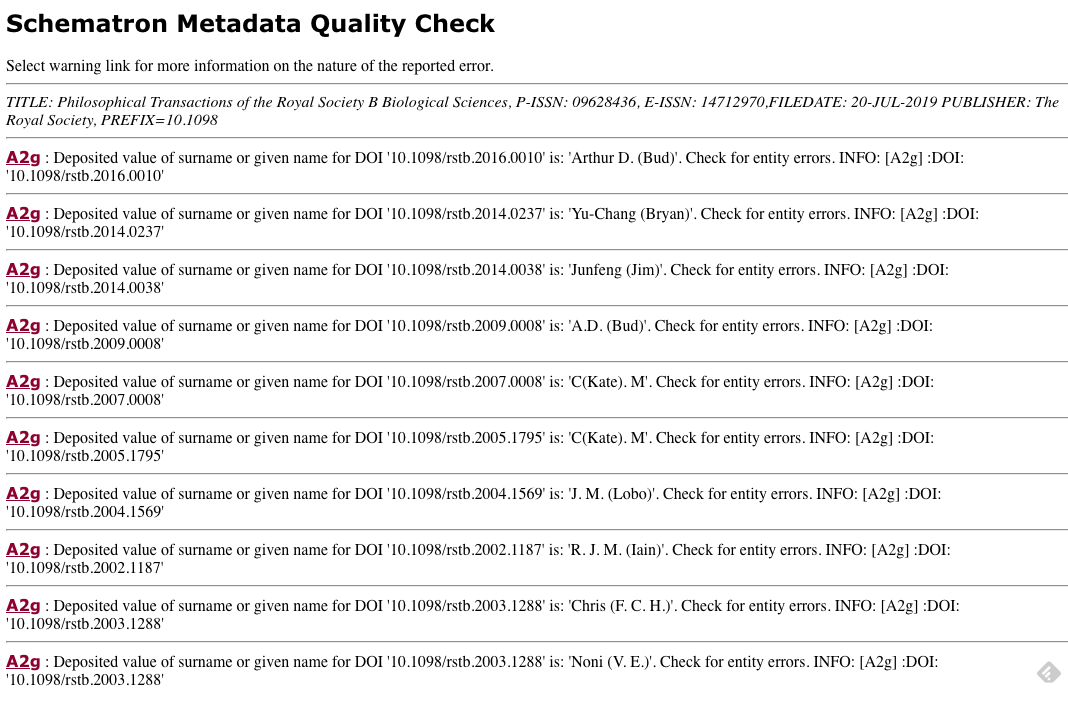
A Schematron report tells you if there’s a metadata quality issue with your records.
Schematron is a pattern-based XML validation language. We try to stop the deposit of metadata with obvious issues, but we can’t catch everything because publication practices are so varied. For example, most family names in our database that end with jr are the result of a publisher including a suffix (Jr) in a family name, but there are of course surnames ending with ‘jr’.
We do a weekly post-registration metadata quality check on all journal, book, and conference proceedings submissions, and record the results in the schematron report. If we spot a problem we’ll alert your technical contact via email. Any identified errors may affect overall metadata quality and negatively affect queries for your content. Errors are aggregated and sent out weekly via email in the schematron report.
What should I do with my schematron report?
The report contains links (organized by title) to .xml files containing error details. The XML files can be downloaded and processed programmatically, or viewed in a web browser: