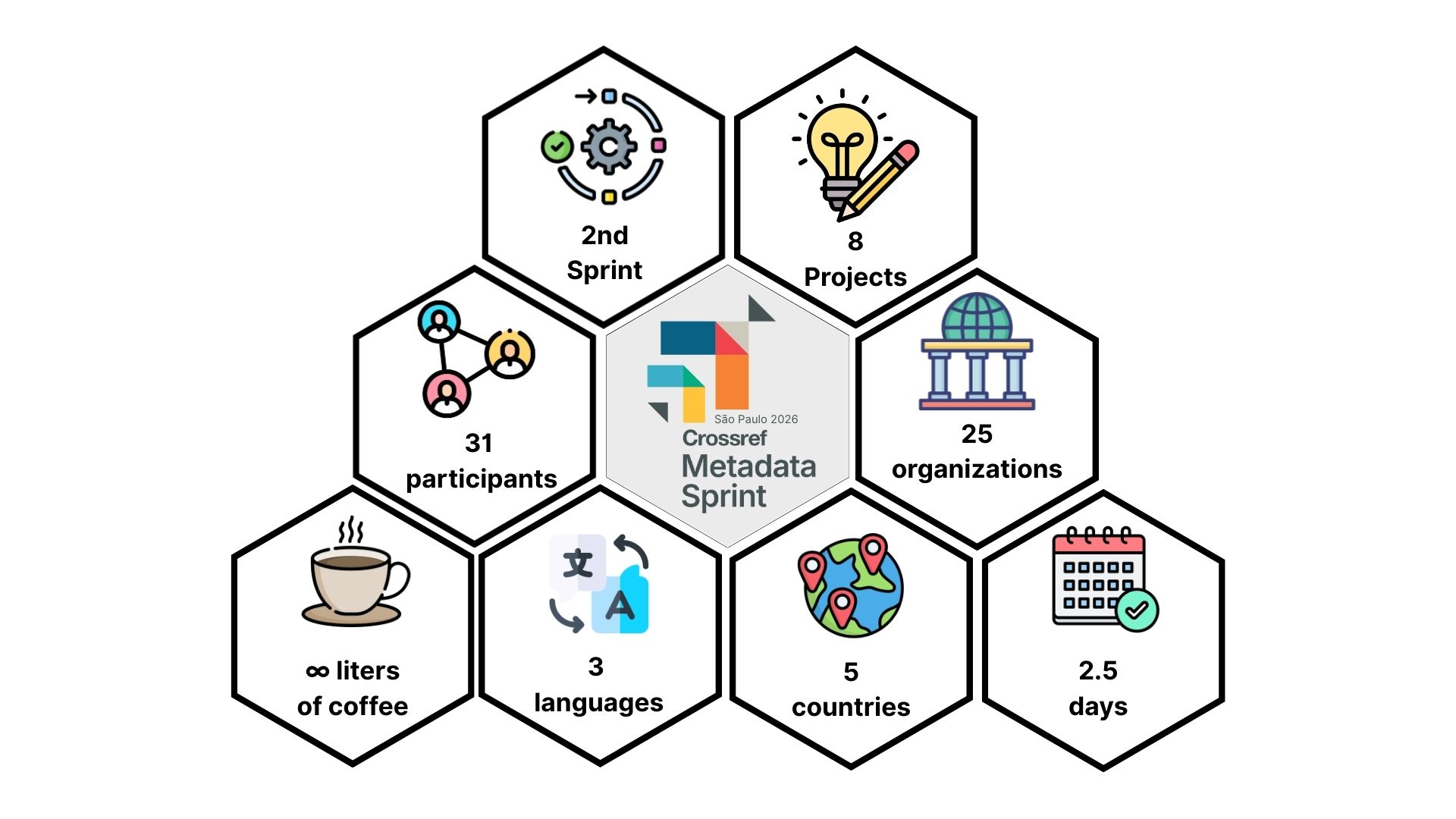
This year, we placed a spotlight on the Latin American community, hosting the second Crossref Metadata Sprint in São Paulo, Brazil from 4 - 6 March 2026. In our first tri-lingual event, we brought together 31 participants from Argentina, Brazil, Colombia, Ecuador, and Mexico. Our goal was to foster community co-creation using the open scholarly metadata. The Sprint was an opportunity to pose questions, share ideas, collaborate on research, and propose innovative solutions that enhance the use of metadata in scholarly communication and beyond.
Read on for more details about the content of the Sprint, and the resulting projects. You can also register to join our Sprint Showcase call on 22nd April to hear directly from the team about their creations.
On 17 March 2026, we experienced an outage that affected DOI resolution for Crossref DOIs and the deposit of metadata records by Crossref members. In this summary, we outline what happened, the impact on our community, and the steps we are taking to strengthen our systems and processes as a result.
We’re excited to announce a new data citation API endpoint and are seeking your feedback. The new service makes existing data citation relationships in our metadata available, thereby surfacing this part of the research nexus. At the same time, we’ve decided that it’s time to move on from Event Data.
Metadata is communication; it can tell a story about research and paint a picture for others to respond to and learn from, across the world and throughout the forthcoming generations. Metadata can feel technical with words like ‘infrastructure’ and ‘schema’, and sometimes, like tech in general, it comes with hyperbole. But metadata really is part art (storytelling and pictures) and part science (structured models and standards) with both aspects being equally important, and requiring people as well as systems. That necessary combination of human and machine involvement also makes metadata challenging.
This year, we placed a spotlight on the Latin American community, hosting the second Crossref Metadata Sprint in São Paulo, Brazil from 4 - 6 March 2026. In our first tri-lingual event, we brought together 31 participants from Argentina, Brazil, Colombia, Ecuador, and Mexico. Our goal was to foster community co-creation using the open scholarly metadata. The Sprint was an opportunity to pose questions, share ideas, collaborate on research, and propose innovative solutions that enhance the use of metadata in scholarly communication and beyond.
Read on for more details about the content of the Sprint, and the resulting projects. You can also register to join our Sprint Showcase call on 22nd April to hear directly from the team about their creations.
We were excited to receive more than 100 expressions of interest for this sprint. We’re excited to see the growing enthusiasm in this space and will find new ways to channel it (watch the space!). We sought to balance that interest with ensuring a productive size of the group for the sprint.
Our participants included librarians, researchers, grad students, developers, journal editors, and scholarly communications professionals. They engaged in rich, multilingual conversations about the different editorial practices across the region - dynamically jumping between Spanish, Portuguese, and English.
We coordinated our activities and ideas with the SciELO Brazil team, who also participated in the Sprint. SciELO is one of the most recognized scholarly organizations in the region and an important source of open scholarly content and metadata; articles, books, preprints, and datasets published in different languages.
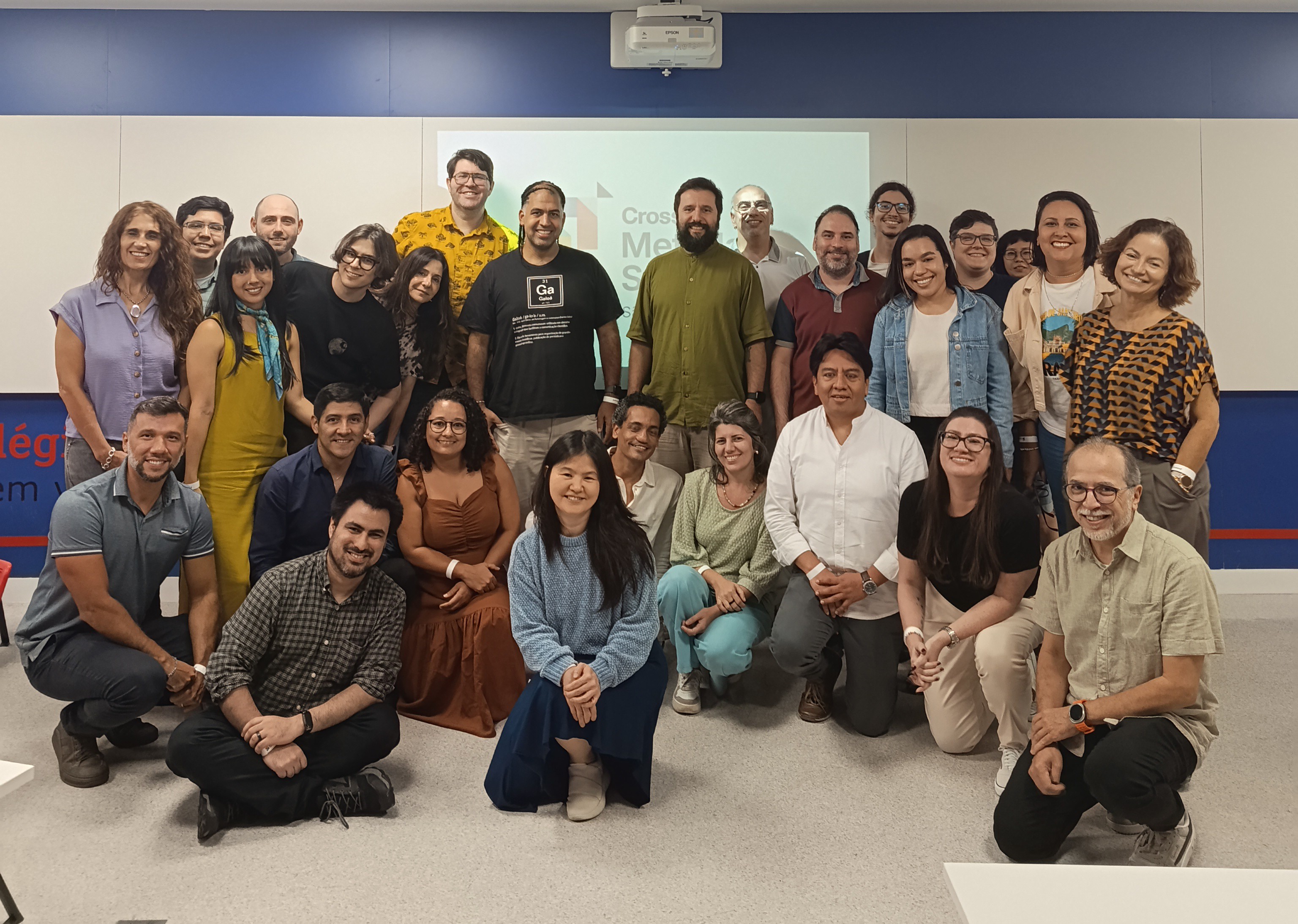
Some of the participants of the 2nd Crossref Metadata Sprint, and Crossref Staff
Susan Collins, Luis Montilla, Isaac Farley, Jason Portenoy, and Leandro Contreras from Crossref acted as facilitators, providing general support, answering questions, and clarifying the ins and outs of Crossref tools and interfaces.
Using the key learning from our first Metadata Sprint, we created opportunities for the group to interact and get acquainted remotely, before the event, to help them hit the ground running and maximise the value of the time we spent together. It really paid off in terms of quality and progress of the sprint projects.
Projects summary
The projects developed also have their own mini stories. When we opened the call for expressions of interest, we invited individual pitches for projects that make creative use of Crossref metadata to answer questions and support solutions to problems faced by our communities locally. During the preparations to the event, participants refined their proposals and coalesced into project teams. This is the list of the projects they progressed during our Sprint:
Crossref Metadata Refiner: A tool that queries the Crossref API for any publisher prefix or ISSN and computes a Crossref Health Score for each DOI, crossing citation count with metadata completeness. The result is a prioritized action list for the member: fix the most-cited papers with the worst metadata first.
Improving Error Messages in Crossref Submission Details: A proposal for the redesign of the presentation of error messages in the Crossref Submission Details interface. Instead of showing only raw XML diagnostics, display structured and human-readable messages.
Scholarly Retractions and Corrections Tool: The development of a user-friendly form for Crossref members to fill in correction and retraction metadata.
Best practices for metadata journals in OJS, according Crossref schema: A guide that shows the correct completion of metadata fields in order to avoid errors already seen in everyday work, and facilitate the correct registration of metadata with the necessary quality to avoid errors in XML export.
Metrics for publishers using the Crossref API: A Power BI dashboard that summarises members’ metrics and indicators based on metadata retrieved from the REST API.
Metadata Integrity Check: A proposal for the implementation of a second stage of XML integrity verification after using the XML parser. This additional step would allow preliminary verification of the presence of mandatory metadata elements and encourage the inclusion of recommended metadata, such as institutional affiliations and references.
Integration OJS / OPS - Crossmark: This project advanced the development of a plugin for the current versions of OJS (3.4 and 3.5), so that when an article receives a correction, update, or new version after publication, each published version of the same work receives its own DOI, while maintaining structured relationships between these versions.
Automated Detection of Reference Rot in Scholarly Web Citations: An automated evaluation pipeline to retrieve citations containing URLs, then traces redirect behavior, and records HTTP status codes and final page locations. It also extracts evidence from both the citation data and the webpage itself, including titles, creators, identifiers, and other metadata.
We will hold a community call where the teams will showcase their projects. If anything here caught your eye and you would like to learn more – join us on 22nd of April (or register to receive the recording). In the spirit of the São Paulo Sprint, we will hold the call in three languages again! Register now to join our Sprint Showcase call.
I am still in awe at what our community achieved in such a short time in the Sprint: dashboards, clever API integrations, best practices manuals… all of these projects are sure to make a mark. The Metadata Sprint in São Paulo is a testament to my belief that great ideas are everywhere, and I’m happy to have taken part in amplifying them!
Said Leandro Contreras, User Experience Researcher
Like many in attendance, this was my first Crossref Metadata Sprint. I went into the event hoping to make connections, help where I could, and learn from those in attendance. Thanks to Susan and Luis for all their planning and thoughtful leadership and the collaborative spirit of everyone participating in São Paulo, the sprint was three days full of rich co-creating, thoughtful shared problem solving, and lots of fun. It exceeded my expectations! I learned a lot and am eager for the next steps with the projects completed there. I hope to be able to participate in another Crossref sprint again very soon (and, encourage everyone reading to get to one in the future)!
Said Isaac Farley, Head of Support
Voices from the Sprint
During and after the Sprint, participants were actively sharing their experiences online. Here are a few highlights from across the community:
Being in this collaborative space allows us to deepen knowledge, exchange experiences with professionals from different countries and, above all, improve the quality of the metadata of our articles. This technical work, often invisible to the reader, is essential to ensure greater visibility, traceability and scientific impact to RBC’s publications.
Carina Munhoz de Lima - Librarian at Revista Brasileira de Cancerologia, on Linkedin, 5 March 2026.
The session was a valuable opportunity to exchange knowledge, strengthen professional ties and reflect on the current challenges around metadata management and scholarly communication.
Sandra Gisela Martín - Library System Director at the Catholic University of Córdoba, on Linkedin, 10 March 2026.
The best experience of the Sprint was recognizing the potential of combining open infrastructure, reusable data and collaboration, with the accompaniment of Crossref experts.
Sofia E. Calle Pesántez - Research Impact and Scholarly Publishing Consultant, On Linkedin, 10 March 2026.
I am grateful to see Crossref’s concern in personally listening to the demands of the Latin American scientific community!
Alex Mendonça - Client Solutions Manager at ScholarOne, on Linkedin, 5 March 2026.
Its been an absolute privilege representing Galoá at the Crossref metadata Sprint in Brazil… our specific focus during this Sprint has been clear: rolling up our sleeves to elevate the quality of metadata for Brazilian and Latin American scientific publications.
Fabiano Sant’Ana - Founder at Galoá, on Linkedin, 6 March 2026
It was wonderful to connect with so many people working to strengthen scholarly communication in the region, and to meet the Crossref staff who organised such a thoughtful and engaging program.
Zach Coble - Graduate Research Assistant, University of Missouri-Columbia, on Linkedin, 7 March 2026
We developed a free tool for registering retractions in the Crossref metadata Sprint… the motivation for the project was to develop a solution that would make the Crossmark registration process easier and more user-friendly.
Eugênio Telles, Genius Design blog, also on Crossref’s community forum. Browse Eugênio’s gallery of photos on Instagram, 8 March 2026
Participants
None of this would’ve been possible without our enthusiastic participants. Huge thanks to everyone! Here is the full list of those who attended our second Metadata Sprint: