In 2020, Crossref’s board voted to adopt the Principles of Open Scholarly Infrastructure, and we completed our first self-assessment. We published our next reviews in March 2022 and December 2024. We are happy to present our latest self-assessment showing there are improvements in a number of areas representing steady progress but there are a few areas to work on and improve.
Ed Pentz, our Executive Director, opened the 2026 Annual Meeting by introducing the theme: Good infrastructure is patient work. Crossref provides foundational infrastructure: an open, persistent scholarly record of metadata, relationships, and identifiers that thousands of tools and services build on. Maintaining that infrastructure and creating lasting value depends on sustained collective effort. True persistence requires active governance, long-term financial commitment, and organisational stewardship.
In 2022, we committed to balancing our working practices and environmental impact, and to openly reporting on those efforts. This is our third report on Crossref’s annual carbon footprint and reflects as much our emissions as it does our learning process. Travel remains the main area of our environmental impact. In 2025, our total emissions were 170 tCO2e, a 3% increase from 2024, with travel accounting for 85% of the total. A big change this year is that we have greater visibility into our AWS-related emissions. With the full transition of our metadata registry and content registration system to the cloud and significantly increased API use, we’re seeing higher carbon costs to host and run our services.
As we approach the end of 2026, research integrity remains a critical focus for the scholarly publishing ecosystem: fast technological advancements are constantly pushing the boundaries of integrity, impacting how everyone in this space interacts with the scholarly record.
We’ve recently reached an important milestone for the research nexus: the works in our metadata corpus are now connected with over 2 billion citation links! This is a great opportunity to share a dedicated dataset and discuss why these are important for science.
The reference metadata is a lifeline of discoverability. Scholars use citations to critique and build on existing research. They acknowledge the contributions of others through references. Our members can then deposit those references as part of metadata with Crossref, and we use those to link the cited and citing objects. This results in complex thematic networks that can be explored by interested researchers. Many tools for research discovery use the linked reference metadata in Crossref to support searches of related content.
The citation links are derived from bibliographic references in the metadata of one work that include DOIs of materials it cites (scholarly works, data, code, etc.). It’s always best if the members can deposit these relationships in full. In a recent post, we shared that nearly half of these links are asserted by our members through metadata deposits, and the other half are created thanks to our automated matching. This form of metadata enrichment happens when members include some information about the references but without the DOI of the cited work, and it’s enough to automatically find and add that DOI. The enrichment supports making data more useful for the community.
The most important impact of citation links is the increased discoverability of connected works. Reference metadata is an important tool for improving visibility and readership of our members’ content. These links are also the foundation of our Cited-by service, which enables implementing members to display citation counts of the work they published on their landing pages.
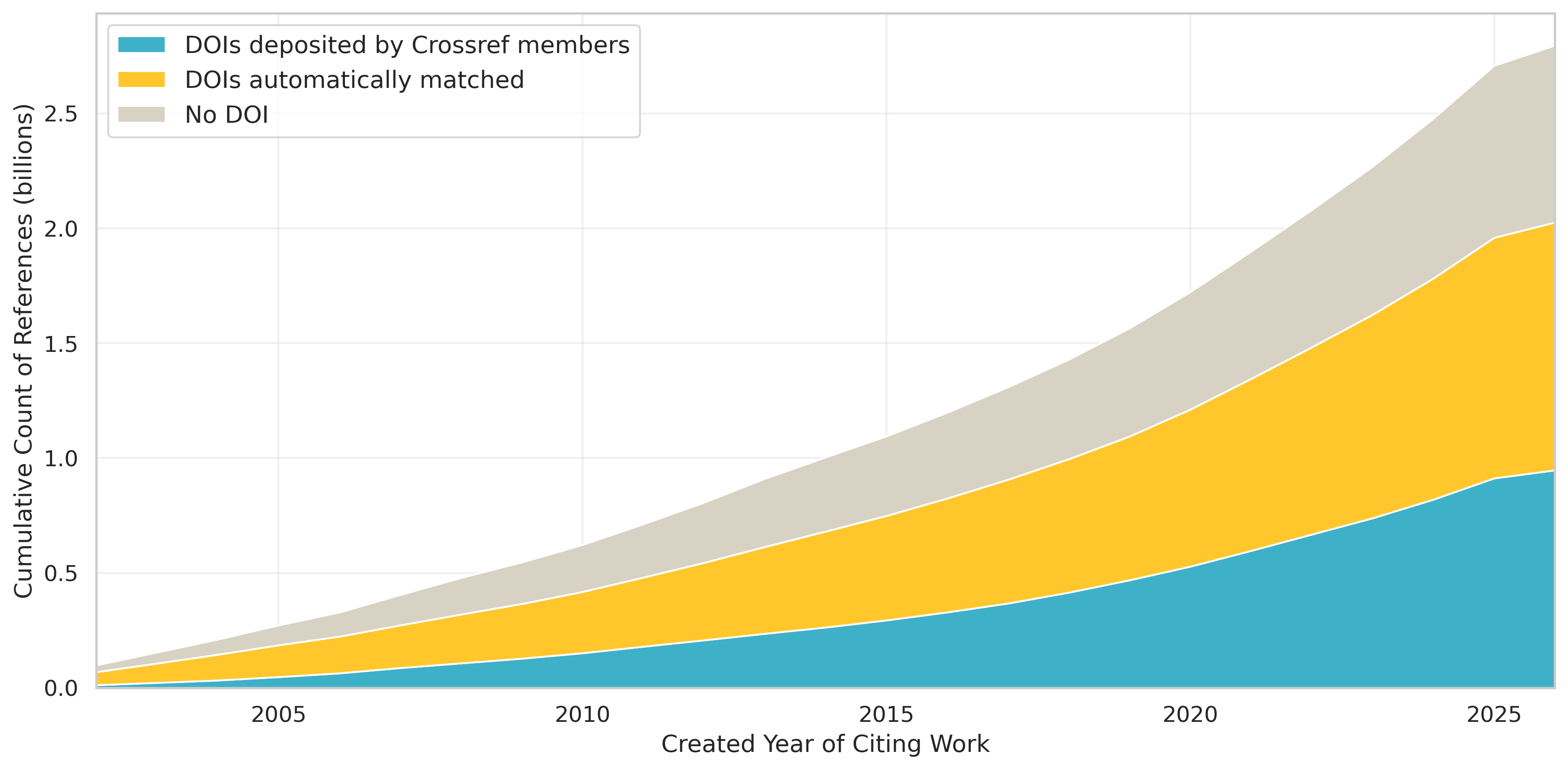
The chart below shows the cumulative count of citations over time, by the created date of the citing DOI’s record. These include records linked by DOI either through member-submitted metadata or matched by Crossref, as well as records that are unmatched. Unmatched records can include records that we were unable to match with the information we have, but also records that truly have no DOI to link to. You can explore the full citation dataset of all 2 billion citation links between Crossref DOIs available now as a (somewhat hefty) download.
Cumulative count of references deposited to Crossref by created date of citing DOI
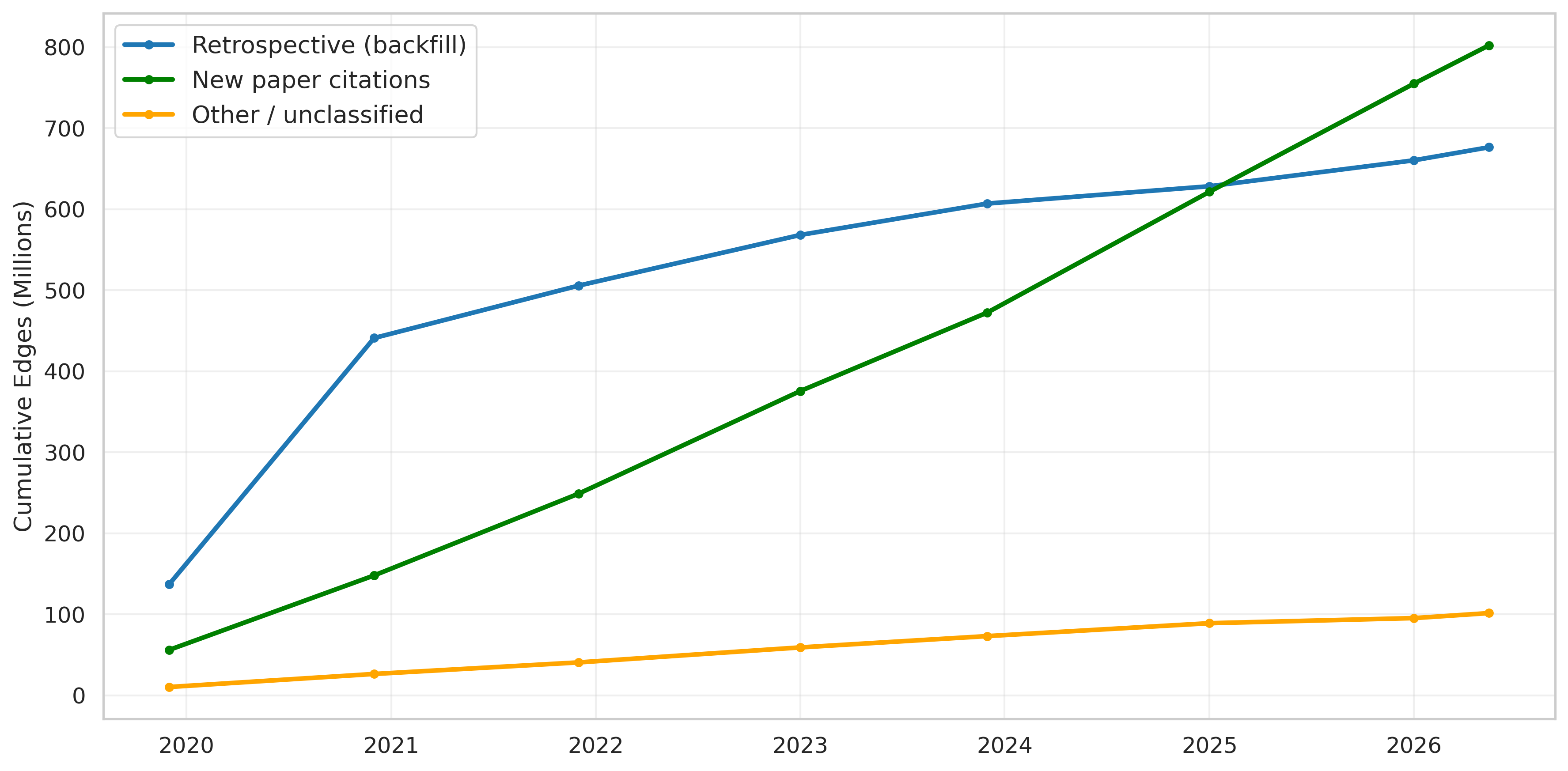
The push for open citation data is something that has unfolded over the last few decades, making more and more of these relationships public. Notably, the growth in citation links reflects not just the output of new scholarship, but also a sustained effort to extend coverage of the historical scholarly record. We can see evidence of this playing out over time by looking at our historical data—periodic snapshots of Crossref’s metadata going back to 2019. When comparing successive snapshots and examining the publication dates of citing and cited works, we can classify each newly appearing citation as either a new paper citation, or a retrospective one. A new citation is where the citing work was published since the previous snapshot, representing real growth in the scholarly record. A retrospective citation is where both papers already existed but the link between them had not yet been captured by Crossref, and these represent indexing catchup rather than new publishing activity.
The chart below shows the cumulative count of citations added in each category since 2019. In the early years of our data, retrospective backfill was the dominant source: the blue line climbs steeply from 2019 to 2021 as a large volume of previously uncaptured historical citation relationships entered the corpus. Over time, however, that rate of backfilling has levelled off. New paper citations, meanwhile, have grown steadily throughout the period, and by 2025 they surpassed the cumulative retrospective total. The open citation ecosystem continues recovering historical links, but the citation network’s growth is now increasingly driven by the natural momentum of scholarly publishing itself.
Cumulative citations added to Crossref by type, 2019–2026. Retrospective citations (blue) represent links to and from works that existed before the previous snapshot; new paper citations (green) come from works published since the last snapshot.
Combined with other metadata for more context, reference metadata supports bibliographic and meta-research on different aspects of the scholarly process, and can support judgements about research integrity and conflicts of interest.
Stereotypically, when talking about references, we consider links to published works (whether preprints, journal articles, or books). However all types of records in Crossref can be cited. Thanks to the changes in our latest schema, members can now signal the types of content that is being referenced. And with our new Data citations endpoint, the community can explore specifically links from Crossref-registered records to research data, including citation links to works within Crossref, as well as DataCite’s corpus.
Close to half of all records registered with Crossref still have none or not enough reference information to make such connections. We invite members to regular Metadata health-check webinars to support them in improving completeness of their records for increased transparency and visibility.
Related reading
Blog
Schema 5.5 now available: adding CRediT, new record types for blogs and posters, and more