Crossref members register around 37,000 records daily. All this metadata is openly shared with the global scholarly community through our free APIs. We receive over two billion calls to our API each month, signalling its use by hundreds of tools and services worldwide, supporting the discovery and assessment of scholarly metadata. As part of a new series in our blog, we will spotlight the diversity of tools and integrations that rely on Crossref metadata to serve the scholarly community. In this initial post, we chat to Luca Foppiano, the developer and maintainer of Grobid1, to learn about how Grobid uses Crossref metadata to improve the extraction and enrichment of bibliographic information from scholarly PDFs.
On behalf of the Nominating Committee, I’m pleased to share the slate of candidates for the 2026 board election. Every active member organisation is invited to submit a ballot to elect the incoming board class.
We’re providing a summary of the board’s July 2026 meeting. The July board meeting is our only in-person meeting. The board gathers for two days of strategic thinking and long-range planning, as well as conducting annual board business. This year, we focused on allocating surplus funds we have on hand to invest in a three-year project to redesign the content system. In a related discussion, we decided to lower content registration fees starting in 2027 because we’ve had a demonstrated history of generating surpluses, exceeding what we need to run Crossref. We also discussed the board structure, as part of our regular review of stakeholder governance. And we conducted annual board business, such as approving the audited financial statements and reviewed our risk register and mitigation plans.
The resolutions are available on the dedicated section of our website, which also lists the members of the Board and offers further information about our governance.
We also managed to squeeze in watching a World Cup game over dinner.
Starting today, funder names deposited in Crossref metadata without an identifier will be matched to ROR IDs, to support an open and connected Research Nexus. Funding information is an increasingly important part of the scholarly record. The improved matching strategy supports researchers, funders, institutions, and meta-researchers, who rely on that information to understand how research is supported and what outcomes that support produces.
As Crossref membership continues to grow, finding ways to help organisations participate is an important part of our mission. Although Crossref membership is open to all organisations that produce scholarly and professional materials, cost and technical challenges can be barriers to joining for many.
Our Global Equitable Membership (GEM) Program aims to provide greater membership equity and accessibility to organisations in the world’s least economically advantaged countries. Eligible members pay no membership or record registration fees. Eligibility for the program is based on a member’s country. Seeing its effectiveness in increasing participation in the research nexus from previously underrepresented regions, this year we are expanding the GEM program to include 18 new countries.
Overview of the first 3 years of GEM
The program began in January 2023 with 214 existing members. By the end of 2025, we had 628 organisations under the GEM program. Of these, 535 are independent members, and 89 members work through one of our sponsors. To date, GEM program members have contributed approximately 334,000 works to the Research Nexus.
Global equitable membership
2023
2024
2025
New members joining
129
127
151
Total member count
327
458
628
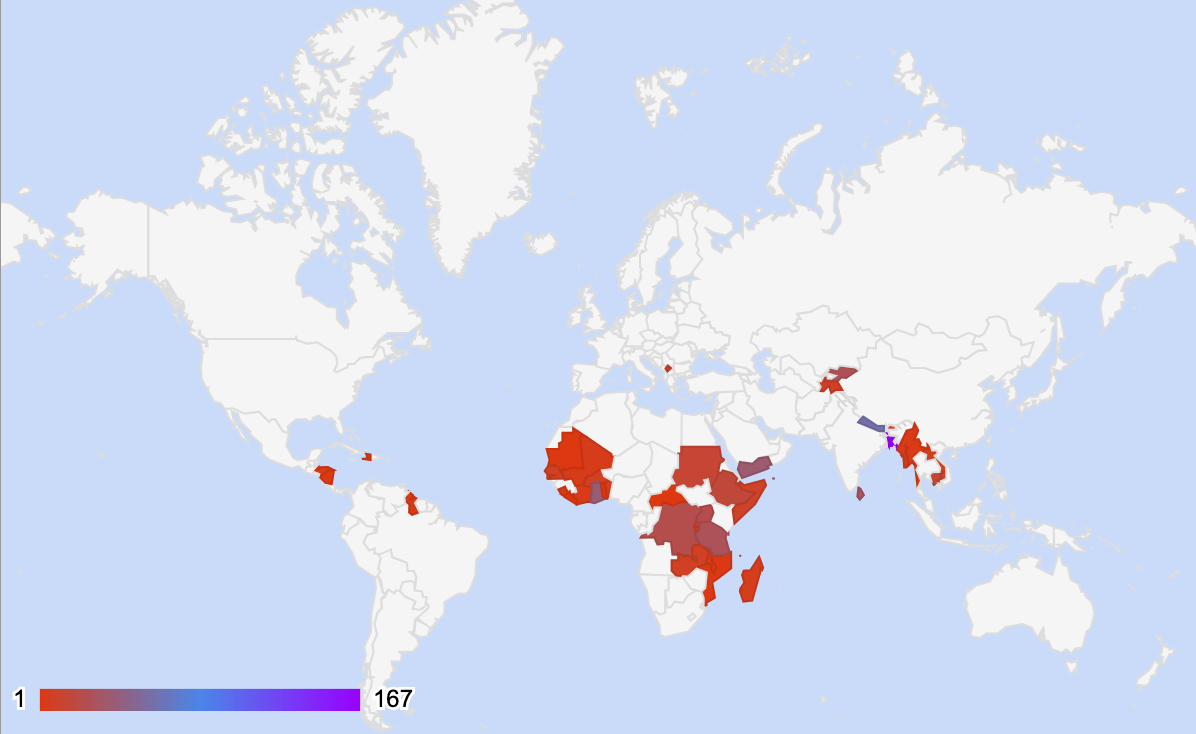
Total number of Crossref GEM members by country until the end of 2025:
GEM country – alphabetically
Total no. of members
GEM country – alphabetically
Total no. of members
Afghanistan
29
Malawi
2
Bangladesh
167
Maldives
4
Benin
6
Mali
4
Bhutan
6
Marshall Islands
0
Burkina Faso
7
Mauritania
1
Burundi
3
Micronesia
0
Cambodia
14
Mozambique
2
Central African Republic
1
Myanmar
3
Chad
0
Nepal
60
Comoros
1
Nicaragua
2
Congo, Democratic Republic
24
Niger
0
Côte d’Ivoire
3
Rwanda
9
Djibouti
0
Samoa
0
Eritrea
0
São Tomé and Principe
0
Ethiopia
17
Senegal
7
Gambia
0
Sierra Leone
2
Ghana
38
Solomon Islands
0
Guinea
0
Somalia
10
Guinea-Bissau
0
South Sudan
0
Guyana
3
Sri Lanka
31
Haiti
2
Sudan
14
Honduras
3
Tajikistan
8
Kiribati
0
Tanzania, United Republic of
28
Kosovo
9
Togo
1
Kyrgyz Republic
27
Tonga
0
Lao, People’s Democratic Rep.
5
Tuvalu
0
Lesotho
0
Uganda
23
Liberia
1
Vanuatu
0
Madagascar
5
Yemen
37
Zambia
8
Membership Density in GEM Program Countries until the end of 2025
Program expansion in 2026
Starting on 1st of January 2026, we’re excited to invite organisations from Angola, Belize, Cabo Verde, Cameroon, Republic of Congo, Dominica, Eswatini, Fiji, Grenada, Kenya, Nigeria, Pakistan, Papua New Guinea, Saint Lucia, Saint Vincent and the Grenadines, Suriname, Timor Leste, and Uzbekistan to join Crossref and register their content and metadata with us without membership or record registration fees. There are 711 existing Crossref members based in these countries who are now eligible for the program, bringing the overall number of GEM members to 1339 across 77 countries (that’s close to 5% of all Crossref members).
In creating our eligibility list, we refer to existing sources. For the first three years of the program, our list was predominantly based on the World Bank’s International Development Association (IDA) classification. In 2026, we leveraged additional sources to curate our list, resulting in the inclusion of 18 new countries in the program. Following community feedback, we now refer to the IDA, the IDA Blend List, and the United Nations Least Developed Countries list. In our choices, we also keep abreast of the global situation and conversations about supporting equitability in scholarly publishing and in the future, we may consider other factors too.
We will review our lists and the eligibility criteria annually and note any changes on our website. Members whose country moves on or off the GEM Program will be notified of any upcoming fees (or the removal of fees) with adequate time to plan and budget accordingly.
Although the GEM program reduces financial barriers, many small organisations may still need administrative, technical, and language support provided by our Sponsors, and we will continue working with suitable organisations to make participation in Crossref easier.