In 2020, Crossref’s board voted to adopt the Principles of Open Scholarly Infrastructure, and we completed our first self-assessment. We published our next reviews in March 2022 and December 2024. We are happy to present our latest self-assessment showing there are improvements in a number of areas representing steady progress but there are a few areas to work on and improve.
Ed Pentz, our Executive Director, opened the 2026 Annual Meeting by introducing the theme: Good infrastructure is patient work. Crossref provides foundational infrastructure: an open, persistent scholarly record of metadata, relationships, and identifiers that thousands of tools and services build on. Maintaining that infrastructure and creating lasting value depends on sustained collective effort. True persistence requires active governance, long-term financial commitment, and organisational stewardship.
In 2022, we committed to balancing our working practices and environmental impact, and to openly reporting on those efforts. This is our third report on Crossref’s annual carbon footprint and reflects as much our emissions as it does our learning process. Travel remains the main area of our environmental impact. In 2025, our total emissions were 170 tCO2e, a 3% increase from 2024, with travel accounting for 85% of the total. A big change this year is that we have greater visibility into our AWS-related emissions. With the full transition of our metadata registry and content registration system to the cloud and significantly increased API use, we’re seeing higher carbon costs to host and run our services.
As we approach the end of 2026, research integrity remains a critical focus for the scholarly publishing ecosystem: fast technological advancements are constantly pushing the boundaries of integrity, impacting how everyone in this space interacts with the scholarly record.
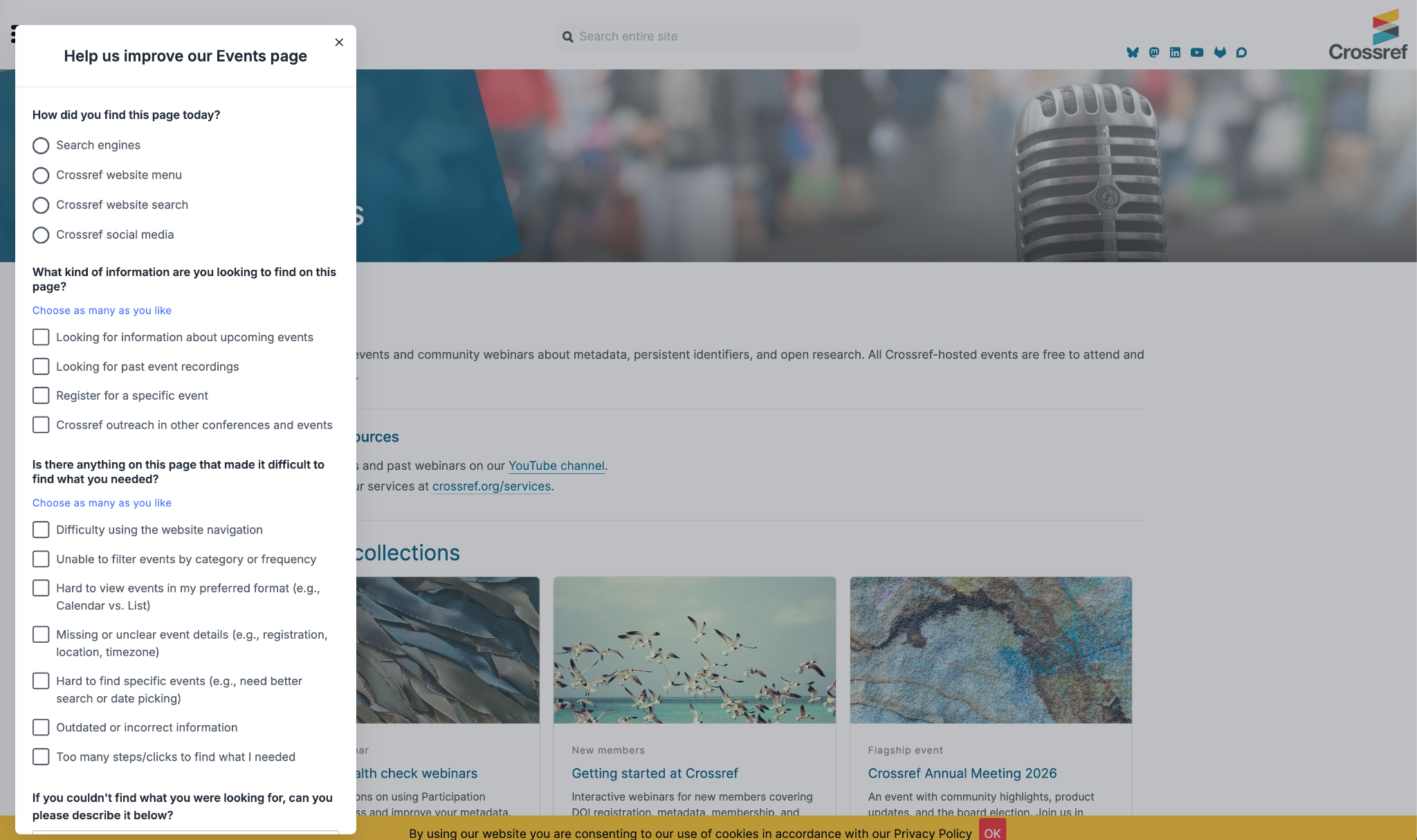
Through user experience research (UXR) initiatives that take into account our diverse membership and community, we can have a continuous, deeper understanding of the role of metadata in our members’ workflows, and ensure that our work continues to meet our community’s needs. Your support is the key to this process, and will positively impact the wider community - and if you’d like to start today, you can take part in our latest initiative: help us improve our Events page by sharing your thoughts on the page’s feedback form.
Hi, everyone! I’m Leandro Contreras, UX Researcher here at Crossref, since February 2026. In previous roles, I helped to design, build and manage digital products and workflows for universities and academic publishers, and now I’m dedicated to bridging the gap between our community’s needs and the tools we build together.
At Crossref, we’re committed to collecting diverse community input, and ensuring our system is representative and useful for everyone that interacts with it. In this blog post, I’d like to introduce you to how we’re kickstarting a more systematic approach to user research processes at Crossref, and invite you to take part in a new research initiative. First, let’s quickly revise some key concepts:
What is user experience?
User experience (UX) is the exploration of how we, as humans, interact with products and services: whether that’s a physical tool or, in our case, the invisible systems holding our metadata, or the visible interfaces that support our community - for example, our Participation Reports.
Good user experience can positively affect people’s day-to-day lives, produce quality results, and champion inclusion: we are more likely to return to a product or a service if it’s tailor-made for us, for our advantages and shortcomings.
What is user experience research?
User experience research (UXR) is the methodical study of users of a product, service or system, using methods to learn about their behaviours, needs, and preferences. While user experience is the design of the experience, UXR is the evidence-based study used to inform those designs and prove they actually work.
In practice, user experience researchers gather this evidence through a variety of methods that seek to capture quantitative and qualitative data. But what are these methods? And how do they apply in the context of an organisation like Crossref, with a growing membership building the research nexus with rich metadata using many different technologies?
How is user experience research taking shape at Crossref?
To understand the role and the impact of metadata across our vast community, we are currently mixing qualitative and quantitative research methods to help us get the right answers:
We use qualitative UX research methods to understand the why and how behind user behaviours, providing descriptive insights - interviewing our members, or observing them while using our services;
We use quantitative UX research methods to obtain measurable evidence that helps us track performance and identify patterns at scale - by sharing surveys and feedback forms with our members, or tracking success/failure metrics in unmoderated testing sessions.
In 2026, we’ve already put these methods to work:
We have collected insights to improve our current website information architecture, through surveys and usability testing at our 2026 Metadata Sprint in São Paulo;
And we conducted a series of usability testing sessions for our upcoming Book deposit flow in the new Metadata Manager tool.
Looking ahead, we’ll continue setting up usability testing sessions, open quick feedback channels on our website, and investigate the impact of research integrity across our membership through surveys. However, these initiatives are only as effective as the community behind them! When you engage in our UXR initiatives, you actively shape current and future Crossref experiences, ensuring they fit your needs.
If you are curious about participating, we’ve just launched a new feedback form on our Events page to detect new improvement opportunities, and we invite you to be part of it. This is a great opportunity to see how our initiatives work in practice, so we hope you’ll jump in!
Over time, you will see the impact of your participation come to life in future improvements to our tools and services through future project updates on our blog, and in the community forum as well. We welcome everyone to join the conversation there. If you have any further questions, suggestions, or collaboration ideas, you can also get in touch via email.
Launching new UX research initiatives at Crossref has been a wonderful way to get to know our community on a deeper level. I’m looking forward to bringing you closer to more initiatives in the future, and learning more from your feedback!
Related reading
Blog
Share your research integrity experiences with Crossref and STM