In 2020, Crossref’s board voted to adopt the Principles of Open Scholarly Infrastructure, and we completed our first self-assessment. We published our next reviews in March 2022 and December 2024. We are happy to present our latest self-assessment showing there are improvements in a number of areas representing steady progress but there are a few areas to work on and improve.
Ed Pentz, our Executive Director, opened the 2026 Annual Meeting by introducing the theme: Good infrastructure is patient work. Crossref provides foundational infrastructure: an open, persistent scholarly record of metadata, relationships, and identifiers that thousands of tools and services build on. Maintaining that infrastructure and creating lasting value depends on sustained collective effort. True persistence requires active governance, long-term financial commitment, and organisational stewardship.
In 2022, we committed to balancing our working practices and environmental impact, and to openly reporting on those efforts. This is our third report on Crossref’s annual carbon footprint and reflects as much our emissions as it does our learning process. Travel remains the main area of our environmental impact. In 2025, our total emissions were 170 tCO2e, a 3% increase from 2024, with travel accounting for 85% of the total. A big change this year is that we have greater visibility into our AWS-related emissions. With the full transition of our metadata registry and content registration system to the cloud and significantly increased API use, we’re seeing higher carbon costs to host and run our services.
As we approach the end of 2026, research integrity remains a critical focus for the scholarly publishing ecosystem: fast technological advancements are constantly pushing the boundaries of integrity, impacting how everyone in this space interacts with the scholarly record.
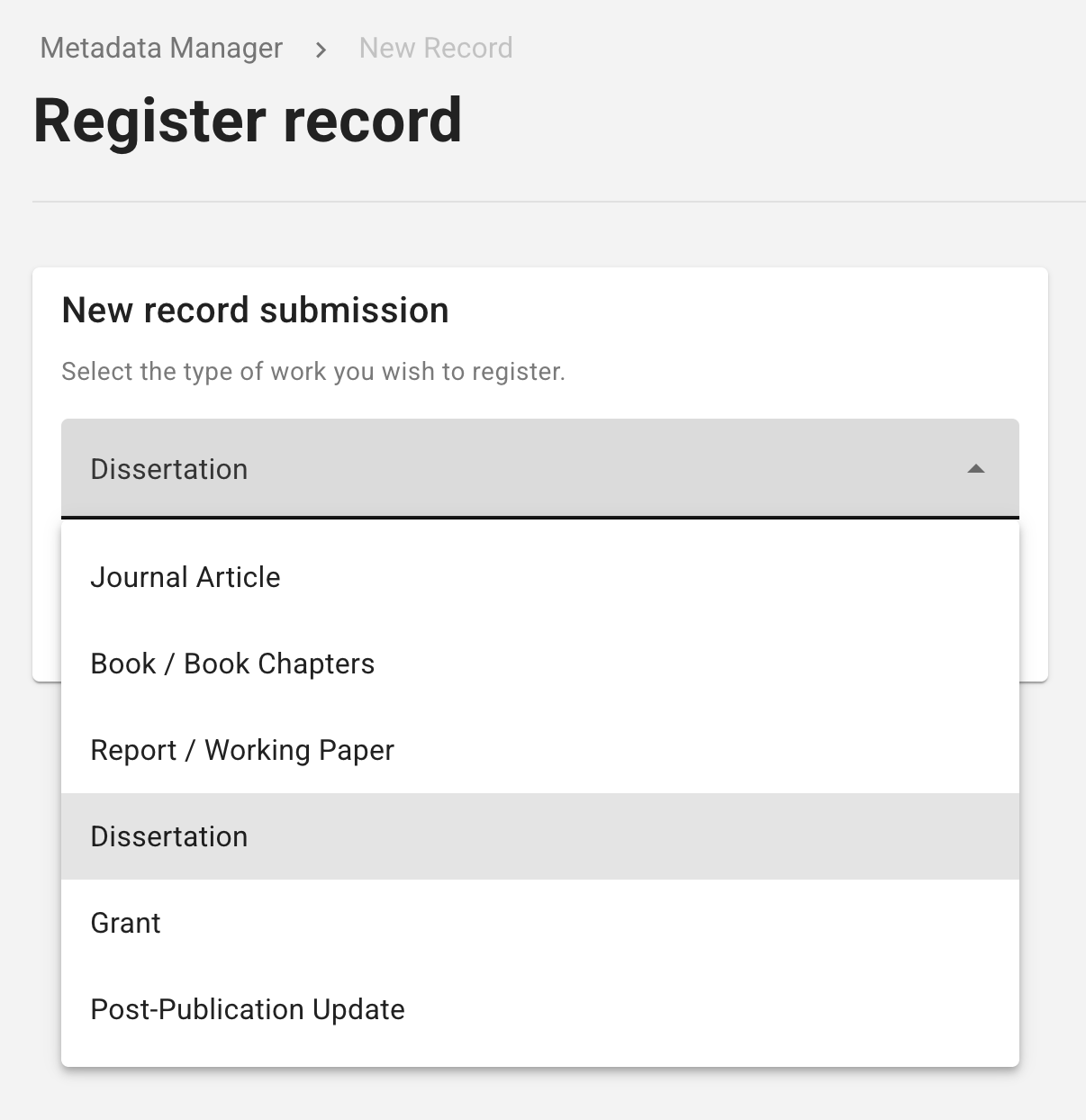
You can now register rich metadata for a variety of record types in Metadata Manager using simple, guided workflows. The tool is used by many in our community to register grant and journal article records, and it has now been expanded to support books and chapters, reports, dissertations, and post-publication updates for journal content.
Update, November 2026: Metadata Manager now also supports registering conference proceedings and conference papers.
Metadata Manager makes it easier to capture identifiers for contributors and their affiliations, funding information, references, and more. Thanks to automated reference matching by Crossref, this offers greater visibility for the works, while the affiliations and funding information can serve as important trust signals for the community.
While all these record types have long been supported through our web deposit form, updated Metadata Manager simplifies the workflow, reduces complexity, and enables metadata updates for registered records. This gives our members the option to register these records along with rich metadata efficiently, without needing to work directly with XML files. We encourage existing web deposit form users to switch to Metadata Manager and the good news is that they can use their existing Crossref credentials to log in.
This is the latest step in expanding Metadata Manager to support more of the record types our members register daily. We retired the legacy Metadata Manager at the end of 2025 partly because it could not be extended to support other record types besides journal content. In contrast, we built the new Metadata Manager in a schema-driven way which makes it adaptable to all parts of our input schema, as well as any future schema changes.
And registering a DOI record doesn’t have to be the end of the story. Metadata Manager makes it easier to manage metadata after registration, allowing members to edit existing metadata directly in the helper tool—without having to re-enter the full record. Updating your records is free, and this new editability makes stewarding your metadata simpler.
In this update, our team focused on the record types members use most often. Our goal was to make DOI registration easier and more accessible.
We are currently working on adding support for registering conference proceedings and conference paper records in Metadata Manager; you can expect to see this next update in the coming weeks.
Why this update matters
Making it easier to register books and chapters, reports and working papers, dissertations, and other research outputs helps ensure more of the scholarly record is described with rich metadata. Better metadata strengthens the links between research outputs, contributors, organisations, grants, and other research objects, supporting the Research Nexus and making scholarly information easier to discover, cite, connect, and reuse. And given the importance of clarity about post-publication updates, such as corrections and retractions, for the integrity of the scholarly record, the Metadata Manager will better support our members to adopt industry best practices that enable self-correcting mechanisms in research.
The new functionality is available to use right away. If you’ve never used the new Metadata Manager, just log in to the tool with the same Crossref credentials you use elsewhere and start exploring the workflow.
Related reading
Blog
The sunset is on the horizon for Metadata Manager. What's next?