In 2020, Crossref’s board voted to adopt the Principles of Open Scholarly Infrastructure, and we completed our first self-assessment. We published our next reviews in March 2022 and December 2024. We are happy to present our latest self-assessment showing there are improvements in a number of areas representing steady progress but there are a few areas to work on and improve.
Ed Pentz, our Executive Director, opened the 2026 Annual Meeting by introducing the theme: Good infrastructure is patient work. Crossref provides foundational infrastructure: an open, persistent scholarly record of metadata, relationships, and identifiers that thousands of tools and services build on. Maintaining that infrastructure and creating lasting value depends on sustained collective effort. True persistence requires active governance, long-term financial commitment, and organisational stewardship.
In 2022, we committed to balancing our working practices and environmental impact, and to openly reporting on those efforts. This is our third report on Crossref’s annual carbon footprint and reflects as much our emissions as it does our learning process. Travel remains the main area of our environmental impact. In 2025, our total emissions were 170 tCO2e, a 3% increase from 2024, with travel accounting for 85% of the total. A big change this year is that we have greater visibility into our AWS-related emissions. With the full transition of our metadata registry and content registration system to the cloud and significantly increased API use, we’re seeing higher carbon costs to host and run our services.
As we approach the end of 2026, research integrity remains a critical focus for the scholarly publishing ecosystem: fast technological advancements are constantly pushing the boundaries of integrity, impacting how everyone in this space interacts with the scholarly record.
With key milestones achieved in 2025, including the appointment of new Directors of Technology and Programs, a move to the cloud, and some key schema updates, we now have a firm foundation for our next challenge: a redesign of our core technical systems to make them more modern, robust, and easier to maintain and scale.
At a high level, our systems serve our community well. The deposit system handles over 107,000 DOI deposits and updates per day, and the REST API responds to 2 billion requests per month, serving up nearly 180 million open metadata records. These systems are reliable: since December 2025, the REST API pools exceeded 99.94% uptime, and the submission queue, since January 2024, has had an uptime of 99.90%.
Uptime for REST API pools and the submission queue, with minimal service interruption since January 2024.
It’s this reliability, we think, that has kept us from tackling this redesign earlier. But the reality is that when these systems were first built, some as long ago as 2005, Crossref and our community looked very different. In 2005, we had 318 members, and were creating DOIs and depositing metadata exclusively for journal articles, all supported by 5 Crossref staff. Today, we have 24,000+ members, representing publishers, societies, funders, universities, service providers, sponsors, and sponsored members; and we are assigning DOIs to >17 content types, from journal articles to book chapters, grants, conference proceedings, dissertations, and more. All supported by 50+ Crossref staff.
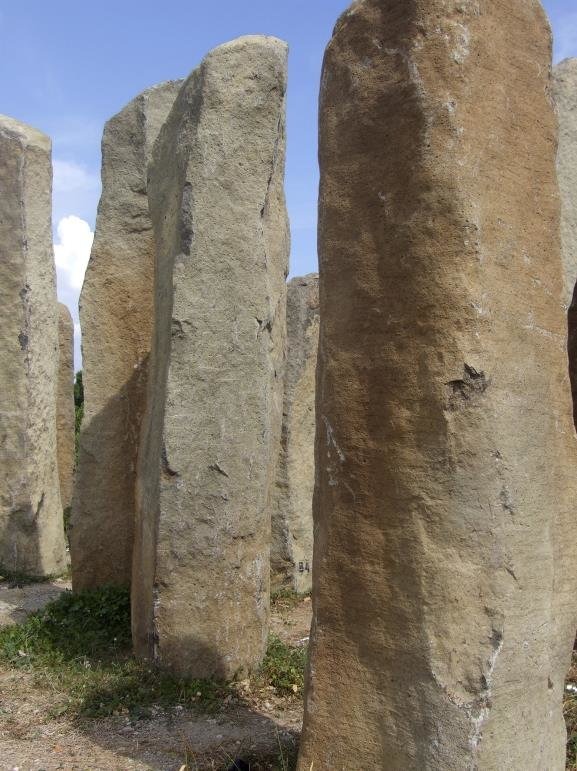
Like a stone monolith, a tightly coupled system can be solid, but hard to adapt.
Over the years, we’ve accumulated quite a bit of technical debt building support for new features and functions into one monolithic codebase.
We haven’t always been great at paying down that technical debt (because, as some say, if it ain’t broke don’t fix it), but we have made big strides in the last 18 months. Our main database moved to Postgres from Oracle and we migrated from a physical data centre to the cloud.
But still, the codebase has become hard to maintain; it’s not always clear that fixing something in one place won’t break something else.
A more modern approach, breaking apart the monolith into separate, smaller services, will enable us to seamlessly maintain services, identify and debug issues efficiently, and build new features to support the ever-changing needs of our growing community.
Paul has recently started a new role at Crossref as the Product Manager for the Open and Sustainable Operations Program and will play a big role in this cross-functional effort. Having moved over from the technical support team, he brings a wealth of experience with all of our systems, how they work in detail, and where the pain points exist for internal users as well as members. We will rely on this experience to bring a better suited system to our members and colleagues.
Oh, the things he’s seen (and heard!). Here’s what rises to the top of his pain points list:
Our authentication service is difficult to administer with manual processes still in place for change requests
Title management causes headaches for our members and staff: members can’t modify or transfer titles between each other in our system themselves and rely on manual intervention from the Support team.
Members don’t have access to all of the details about their own records that we have in our system. This creates unnecessary barriers to stewarding their metadata.
Members can’t currently programmatically check the status of their submission in the system to learn in real-time whether it has been deposited or remains in the queue, which would be really useful.
How are we going to do this?
This won’t be one big bang – the scale is way too big, and it’s far too risky. We will instead break the work into a series of (many!) smaller projects, chipping away at the large monolith of Crossref code and building smaller, free-standing components which will be easier to maintain. We also don’t see this work as a separate project with a cleanly defined beginning and end - rather, gradually replacing parts of the system with more modern, better-designed components is simply part of ongoing maintenance.
We’ve already taken a hard look at what our system does (and it’s a lot!) and developed a list of ~14 core “functions” it serves, things like authentication and authorization, metadata deposit and validation, metadata distribution, and so on. We’ll work on replacing those functions with free-standing services, then pull out the (then-unnecessary!) code from the codebase. At each step, the monolith gets smaller and less complex.
We’ve already started doing this, and it feels great! Most recently, we rebuilt a component we lovingly call the ‘Pusher.’ Its function is to push the XML our members deposit to the REST API, where it can be distributed to users, and to keep citation counts updated. We deployed the new Pusher in two phases, in October 2025 and February 2026. It uses modern code libraries, is open source, and runs independently rather than being tangled up with the rest of the core system.
Another project that is currently underway is rebuilding of our metadata matching workflows using modern software development and data science practices. The goal is to create a dedicated, consolidated matching service that will eventually replace all existing matching processes, with results made available through the REST API. This project will start with matching funder names to ROR IDs, and eventually cover also bibliographic reference matching, preprint matching, affiliation matching, grant matching, and title matching.
We have yet to decide on the exact order of things, but that will likely be determined by the complex dependencies we touched on earlier. We’ll also consider urgency and risk - is something falling over too often and causing too much work to maintain it and keep it stable? That’s the reason we bumped up the priority on the Pusher work and rewrote it when we did. We’ll also consider benefits: quicker upgrades which will help both ourselves and our members will naturally have a higher priority than less impactful projects.
We do know that the top priority is the authentication service. The current one was not meant to be permanent, but rather a bridge until we build a permanent solution. It’s now beyond its useful life: it’s quite confusing, it doesn’t scale (and we are scaling), and it’s painful for sponsors, members, and Crossref staff. Tackling this piece of work first unblocks a lot of other important things we want to get done. It’s a big undertaking that we are excited to get started on to improve the user experience for everyone. Importantly, we will be consulting with the community along the way so that we get this right.
Dominika Tkaczyk, Crossref Director of Technology, emphasized the importance of maintaining open scholarly infrastructure at the Crossref annual meeting in October 2025. She said that, just as we maintain roads and bridges to make sure they’re safe, we must maintain scholarly infrastructure so it continues to serve the community far into the future.
This is a long road, but it’s one we’re excited to be on. We’ll have periodic updates on our progress as this work goes forward: what we’re getting done, where we need input, and what we’re tackling next. We’ll need a lot of feedback from you, our community, about what’s working well and where we might make improvements.
Related reading
Blog
Investing $4.9 million of our surplus in rebuilding the Crossref system