In 2020, Crossref’s board voted to adopt the Principles of Open Scholarly Infrastructure, and we completed our first self-assessment. We published our next reviews in March 2022 and December 2024. We are happy to present our latest self-assessment showing there are improvements in a number of areas representing steady progress but there are a few areas to work on and improve.
Ed Pentz, our Executive Director, opened the 2026 Annual Meeting by introducing the theme: Good infrastructure is patient work. Crossref provides foundational infrastructure: an open, persistent scholarly record of metadata, relationships, and identifiers that thousands of tools and services build on. Maintaining that infrastructure and creating lasting value depends on sustained collective effort. True persistence requires active governance, long-term financial commitment, and organisational stewardship.
In 2022, we committed to balancing our working practices and environmental impact, and to openly reporting on those efforts. This is our third report on Crossref’s annual carbon footprint and reflects as much our emissions as it does our learning process. Travel remains the main area of our environmental impact. In 2025, our total emissions were 170 tCO2e, a 3% increase from 2024, with travel accounting for 85% of the total. A big change this year is that we have greater visibility into our AWS-related emissions. With the full transition of our metadata registry and content registration system to the cloud and significantly increased API use, we’re seeing higher carbon costs to host and run our services.
As we approach the end of 2026, research integrity remains a critical focus for the scholarly publishing ecosystem: fast technological advancements are constantly pushing the boundaries of integrity, impacting how everyone in this space interacts with the scholarly record.
We aim to fix that. Crossref and Wikimedia are launching a new initiative to better integrate scholarly literature in the world’s largest public knowledge space, Wikipedia.
This work will help promote standard links to scholarly references within Wikipedia, which persist over time by ensuring consistent use of DOIs and other citation identifiers in Wikipedia references. Crossref will support the development and maintenance of Wikipedia’s citation tools on Wikipedia. This work will include bug fixes and performance improvements for existing tools, extending the tools to enable Wikipedia contributors to more easily look up and insert DOIs, and providing a “linkback” mechanism that alerts relevant parties when a persistent identifier is used in a Wikipedia reference.
In addition, Crossref is creating the role of Wikimedia Ambassador (modeled after Wikimedian-in-Residence) to act as liaison with the Wikimedia community, promote use of scholarly references on Wikipedia, and educate about DOIs and other scholarly identifiers (ORCIDs, PubMed IDs, DataCite DOIs, etc) across Wikimedia projects.
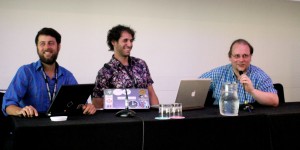
Starting today, Crossref will be working with Daniel Mietchen to coordinate Crossref’s Wikimedia-related activities. Daniel’s team will be composed of Max Klein and Matt Senate, who will work to enhance Wikimedia citation tools, and will share the role of Wikipedia ambassador with Dorothy Howard.
Since the beginnings of Wikipedia, Daniel Mietchen has worked to integrate scholarly content into Wikimedia projects. He is part of an impressive community of active Wikipedians and developers who have worked extensively on linking Wikipedia articles to the formal literature and other scholarly resources. We’ve been talking to him about this project for nearly a year, and are happy to finally get it off the ground.
-G
]7 Matt, Max and Daniel at #wikimania2014. Photo by Dorothy.